
Contents
- 1 Overview of Predator Hunting Caliber Basics
- 2 Most Popular Predator Hunting Calibers
- 3 Comparison Table for Predator Calibers
- 4 How to Pick What’s Right for You
- 5 Gear and Rifle Considerations
- 6 Common Challenges When Choosing Caliber
- 7 Advanced Predator Hunting Tips
- 8 Real-World Caliber Choices in Different Situations
- 9 Frequently Asked Questions
Picking the best caliber for predator hunting can make your time in the field smoother and more enjoyable. The right round brings together both effectiveness and ease of use, which is really important when you’re after animals like coyotes, foxes, or bobcats.
QUICK LOOK: Most Popular Calibers for Predator Hunting
- .223 Remington / 5.56 NATO: Light recoil, accurate, and the ammo is everywhere and easy on the wallet. The flat flight path means I’m confident at 300 yards if I have a solid rest. Using an AR-15 with .223 gives lots of flexibility, whether stalking or calling predators.
- .22-250 Remington: This round is built for speed and shoots flat as a table. I often reach for it if my setups require long shots—think open country with skittish coyotes. It delivers an impressive punch far downrange.
- .204 Ruger: When pelts matter or quick, low-recoil shots are the goal, .204 Ruger shines. With speeds up to 4,000 fps and light, zippy projectiles, it’s perfect for foxes and bobcats, and it helps minimize fur damage, which can be important if you want to cash in on the pelts.
- .243 Winchester: For a true all-in-one approach, .243 Win brings the right mix of power and reach. It cuts through wind, works well for deer, and anchors coyotes consistently at long distances.
- 6.5 Grendel: Built for AR-15s but offers more muscle than a .223, the 6.5 Grendel gives a nice bump in hitting power downrange. It’s my pick if there’s a chance of running into large coyotes or hogs alongside other predators.
Over time, I’ve learned that different predator species, hunting environments, and rifle platforms can influence which caliber feels just right. In this article, I’ll break down the options, with pros, cons, and the real-world tricks I use to pick my favorites.
Overview of Predator Hunting Caliber Basics
Predator hunting means chasing animals that are quick, alert, and sometimes pretty clever. In the U.S., coyotes, foxes, and bobcats are the stars of the show. Picking the right caliber impacts your effective range, how accurate you’ll be, recoil, cost, and even how usable the pelts are later.
Four things matter most for me: terminal performance (how well the round brings down an animal), trajectory (how flat and predictable the bullet’s path is), recoil (how hard the rifle kicks), plus ammo cost and how easy it is to find. Coyotes are often the main focus, and they require a caliber with enough punch for an ethical hunt.
Most hunters, myself included, look for an all-in-one choice that shoots well, doesn’t blow up their shoulder, and is versatile for a mix of predators. The most popular picks balance these needs and pop up again and again in hunting circles, and for good reasons.
Most Popular Predator Hunting Calibers
Let’s check out the most talked-about calibers I spot in the field and in online hunting groups. Each one has its best use, depending on your hunting style and target species.
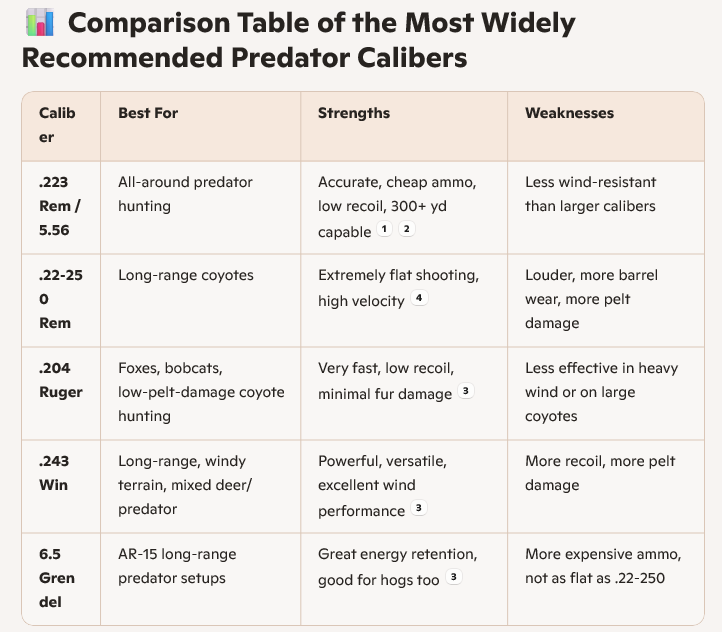
- .223 Remington / 5.56 NATO: My personal favorite for most hunts. Light recoil, accurate, and the ammo is everywhere and easy on the wallet. The flat flight path means I’m confident at 300 yards if I have a solid rest. Using an AR-15 with .223 gives lots of flexibility, whether stalking or calling predators.
- .22-250 Remington: This round is built for speed and shoots flat as a table. I often reach for it if my setups require long shots—think open country with skittish coyotes. It delivers an impressive punch far downrange.
- .204 Ruger: When pelts matter or quick, low-recoil shots are the goal, .204 Ruger shines. With speeds up to 4,000 fps and light, zippy projectiles, it’s perfect for foxes and bobcats, and it helps minimize fur damage, which can be important if you want to cash in on the pelts.
- .243 Winchester: For a true all-in-one approach, .243 Win brings the right mix of power and reach. It cuts through wind, works well for deer, and anchors coyotes consistently at long distances.
- 6.5 Grendel: Built for AR-15s but offers more muscle than a .223, the 6.5 Grendel gives a nice bump in hitting power downrange. It’s my pick if there’s a chance of running into large coyotes or hogs alongside other predators. Ammo is less common, but the extra knockdown power is worth it for some trips.
Comparison Table for Predator Calibers
How to Pick What’s Right for You
The right caliber for predator hunting depends on your target animals, favorite rifles, local conditions, and personal aims. I usually ask myself these:
- Will most shots be close up, or do I need to reach out to 400 yards?
- Do I want pelts in good shape for the market or display?
- Do I prefer hunting with a bolt-action or an AR rifle?
- Is this a one-and-done setup handling predators and deer?
If I’m trekking across rough territory, my.223 Rem is light and gets the job done. For planned long shots or big open fields, .22-250 Rem comes into play. Areas loaded with smaller game or if fur is the priority, .204 Ruger gets the nod—it helps keep the animal’s hide intact and is flat-shooting for precise shots.
Don’t disregard the role of the cartridge for areas with public land or private farms—certain regions may have caliber restrictions, and noise or range limitations matter, especially near livestock or other hunters.
Gear and Rifle Considerations
Choosing the right rifle is just as important as caliber. AR-15s mean quick follow-up shots for moving game, and .223 or 6.5 Grendel chamberings give plenty of flexibility. Bolt-action rifles chambered in .22-250 or .243 Winchester give me a little more reach and often better accuracy for those challenging long-distance shots. The weight and quality of the barrel are critical too, especially for lots of walking or tough conditions.
Your optics can make or break a hunt. I like a good variable zoom scope with clear lenses and sharp reticles. Early morning and twilight hours, when predators are most active, call for glass that gathers plenty of light. When looking for the ultimate lightweight setup for all-day hunts, a compact rifle, a simple bipod, and just enough gear for quick shooting keep things agile.
On ammo selection, for typical coyote hunting, I use light, fast varmint bullets that expand fast and drop game quickly. If there’s a mix of heavier animals, moving up to a slightly heavier bullet weight helps with penetration through fur and bone.
Common Challenges When Choosing Caliber
Expense and recoil are stubborn obstacles for many. If I know I’ll knock out dozens of rounds on a single trip (for practice or a full morning of calling), I look for bulk ammo deals or reload my own to keep costs reasonable—here the .223 and .204 Ruger really shine.
Lightweight rounds also mean less fatigue from recoil, so I stay accurate all day. A big challenge is wind. Light, fast bullets can drift, so handling wind becomes a skill you’ll want to master. Rounds like .22-250 and .243 Winchester offer more weight and speed, cutting through gusts better for those distance opportunities.
Picking a forgiving caliber if you’re new to reading wind is always wise. For avid shooters, barrel wear is something to look out for. Fast rounds like .22-250 can wear a barrel out quicker if you shoot a lot—keeping an eye on your gear’s condition pays off in the long term.
Advanced Predator Hunting Tips
As you get comfortable with your rifle and setup, a few new tricks can step up your skills and results:
Practice at real distances: Set your rifle’s zero at 100 yards, but get familiar shooting at 200, 300, or even 400 yards if your local range allows. The more time you spend stretching things out, the readier you’ll be when a coyote pops up across a big field.
Pick the right scope: Good glass helps you spot game through brush and shoot in dim light. I like clean, uncluttered reticles for quick holds.
Try handloading: Rolling your own ammo boosts consistency and lets you tailor bullet styles, which can control fur damage or maximize accuracy.
Keep it simple: Less is more when hiking. A lightweight, well-balanced rifle and just basic shooting sticks keep you steady and mobile in all conditions.
Real-World Caliber Choices in Different Situations
Here’s how I match up my caliber with the hunting conditions I face:
- Lots of foxes and bobcats in a spot? I’ll use the .204 Ruger to take quick, accurate shots without ruining the hides.
- In farmland or mixed woods, or if deer might show, the .243 Winchester covers both bases and handles gusty days very well.
- For calling predators in close, especially around farm animals, a .223 Rem stays quiet, prevents unnecessary disturbance, and is still effective at 200 yards.
- If long shots and wind are the norm, .22-250 Remington or .243 Winchester stand out. Their heavier bullets hold up better over distance and in breezy weather.
Frequently Asked Questions
What’s the best caliber if I’m worried about pelt damage?
.204 Ruger and .223 Remington both help keep pelts in good condition. The .204 is outstanding for foxes and bobcats, while a lightweight .223 works well for coyotes if you pick the right bullet.
Can I hunt predators and deer with the same rifle?
Yes. .243 Winchester is a top crossover—it can drop a deer and still is fast and flat enough for coyotes. Just switch bullet weights as needed.
Is the .22-250 Remington too much for smaller predators?
It can cause extra damage to delicate pelts, so I only use .22-250 for long-range coyote hunts or when pelts aren’t a concern.
What caliber works best in AR-15s?
.223 Remington is the cost-effective, easy-to-find workhorse. The 6.5 Grendel gives more power for larger predators but is more expensive and a bit harder to source.
Dialing in your perfect predator caliber is a process. With a little trial and error, you’ll spot what fits your own hunting style, terrain, and typical targets. The right choice will help you hunt more confidently, get cleaner kills, and maybe even put some nice pelts on the wall this season.
Most Recent Articles:
- Communication In Remote Hunting Areas With No Cell Service

- Eberlestock Backpacks: Customizing Your DIY Hunting Loadout
- DIY Weekend Warrior Hunting Trips
- Leupold’s Precision Scopes: Elevating DIY Hunting Accuracy
- Without a GPS Signal How do You Navigate Backcountry Trails?

- Vortex Optics Essentials: Hunting Scope Guide For The Serious Outdoorsman
As always, stay safe, enjoy the journey, and please try to leave it cleaner than you found it. If you have any comments, questions, ideas, or suggestions, please leave them in the comment section below, and I’ll get back to you ASAP. You can follow us on YouTube: Man Art Creations for videos of our DIY Adventures.
P.S. Thanks so much for checking out our blog; we really appreciate it. Just so you know, we may receive a commission if you click on some of the links that appear on our site. This helps us keep our content free and up-to-date for everyone. We appreciate your support!